Showing posts with label Video. Show all posts

The Sustainability Hat-Trick

How integrating the three pillars of sustainability in to your decision making will make you a winner every time.

A History Lesson
In 1835 an English Cricketer by the name of Heathfield Harman "HH" Stephenson was the first to take three wickets in three balls. Later HH Stephenson was awarded a hat for his achievement and the term “Hat-Trick” was coined. Since then the term has been adopted to explain significant achievements that come in threes, like three goals in Hockey, Football/Soccer, or as in golf three consecutive wins of the same Tour event constitutes a “Hat-Trick”.

In March of 1987 the Brundtland Commission of the United Nations agreed that the definition of “Sustainable Development” is “development that meets the needs of the present without compromising the ability of future generations to meet their own needs.” Later in 2005 at the World Summit held in New York City, it was agreed upon by the participating nations that to attain sustainable development it would require reconciliation of environmental, social and economic demands. This became known as the “Three Pillars” of sustainability, but also referred to as the 3 P’s: People, Planet, Profit.


Image Source 


Integrated - It’s not just for Pest Management anymore!
The “reconciliation of environmental, social and economic demands” means that development, or in our case individual projects or products, must account for each of these areas. A single focused solution is a temporary response to a problem and is based on a system of cheap and easily accessible fuels, materials and labor. This is the difference between “sustainability” and single focused methods of making something just “green”, “cheap” or “aesthetically pleasing”. The old linear decision making process of “I have one problem and therefore need one solution” does not take into account the effect on the inputs and outputs of the 3 P’s. At this time in our game, economy and environment, we need a major win. I believe that sustainable planning can deliver us this win.

So what are the dimensions of the Cultural, Economic and Environmental functions related to a golf course?

Cultural Dimensions of Golf Course Management

  • To provide recreational opportunities
  • To make golf accessible
  • To promote the rules of golf
  • To make golf fun, playable and provide advancement opportunities
  • To embrace the historic cultural aspects of the game
  • To provide a venue and activity for community events and functions
  • To provide a social venue for special occasions (banquets and weddings)
  • To preserve and protect the health of peoples

Economic Dimensions of Golf Course Management

  • To provide employment opportunities
  • To provide services to local businesses (catering, conferences and banquets)
  • To use the services of other local companies to advertise, maintain and supply the golf course
  • To provide a fundraising opportunity for local charities
  • To generate electricity, fuels, materials for local use
  • To increase efficient use of resources
  • To reduce overhead costs

Environmental Dimensions of Golf Course Management

  • To provide functional habitat and embrace biodiversity
  • To contribute to the naturally occurring water cycle (recharge groundwater reserves, direct high flows, preserve low and seasonal flows)
  • To filter water and improve overall water quality
  • To sequester carbon and preserve air quality
  • To cool surface temperatures and reduce the heat island effect of urban areas
  • To process and use local green waste products

It is with the integration of these three dimensions that I believe golf can be a truly “sustainable” sport.

---


And just for the fun of it, here's a game every Leaf fan remembers featuring the "Greatest" Hat-Tricker of them all, #99. 

Dirt vs. Soil: What is under your turf?

A key principle of sustainability is to cooperate with nature instead of competing with it, are you doing this with your soil microbiology?

In this video from sustainablestudiesinstitute.org, Dr. Elaine Ingham talks about soil fertility and the role of soil microbial life. Dr. Ingham is a world-renowned soil biologist who pioneered many of the currently used biological soil amendment techniques and the testing of soil microbial life as an indicator of soil and plant health. Her position on soil management is controversial in some circles, while gospel in others.

What is your take? Comment below or use #soilfoodweb on twitter or G+


Environmental Efforts at New Albany GC

Discussion with Adam Troyer and Brett Foster about New Albany Country Club's recent Audubon Certification. Produced by the Ohio Turfgrass Foundation.


Newcastle Experiments with Composts

"We did some trial work on compost and have been pretty happy with the results. We have found some of the batches vary in freshness so where and when you use it could be a concern. Overall though, using it in our divot mix has been great for speeding up germination and divot recovery. It is also showing significant promise in our high wear and droughty areas." - 

From Scott M. Phelps on the Newcastle Turf Maintenance Blog

Check out Cedar Grove for more info on their Compost Products


How Golf Preserves

From GCSAATV:
Golfpreserves founders discuss their work in developing a monetary value for carbon sequestration on golf courses that can be used to help fund environmental research and stewardship efforts.

Greg Evans: 3 Beliefs in Producing a Successful Putting Surface

In this video from the 2012 GCSAI Conference this past week in Killenard Ireland, Greg Evans MG lays out his 3 beliefs of what is necessary to produce a successful putting surface:
  1. Single Grass Species - Pick a parent monoculture and put a maintenance plan together to maximize its potential. Whether that's Fescue, Bent or perennial Poa, to get the best out of each species you must focus on each one individually.
  2. Maintain a Balanced Program - Too little is as bad as too much in my view. Also, consistency of height of cut is crucial so that the grass plant grows in a happy environment. Chopping and changing building up to the big tournament is no good!
  3. Sward Density - Without doubt the key to producing good surfaces. However you do it, you must maintain high sward density to get the best out of your surfaces.

Be sure to check out Greg's Blog and follow him on Twitter.

Top 5 Dirty Videos

Understanding how soils work plays an important part in choosing plant materials, cultural methods, and interpreting what is happening below your feet. Here are five videos covering the basics...

#5 - Soil Texture


#4 - Soil pH


#3 - Soil Carbon Sequstration


#2 - Soil Biology


#1 - Water Movement in Soil

Video: Getting - and keeping - the bugs out

Last year at the 2011 Cornell Landscape Webinar Series: Getting Your Turf on the Right Track, sponsored by Cornell Cooperative Extension Sustainable Landscapes-Horticulture Program Work Team, Cornell University Assistant Professor & Turfgrass Entomologist Dan Peck, Ph.D., discussed the early-season scouting and intervention strategies for Invasive Crane Flies, Annual Bluegrass Weevil, Chinch Bugs and White Grubs.

Video: James Baird Interview

James Baird, a turfgrass specialist at the University of California, Riverside, talks about cool- and warm-season grasses, their carbon sequestering abilities, and how these grasses respond to water. In this interview, he also offers homeowners some lawn-care advice.

Organic Golf Course Management in Utah

Utah State University has identified Utah to be a perfect model to explore the use of organic management strategies on golf courses because of its diverse climates and landscapes that reflect those throughout the Intermountain Western US. As a means to increase awareness to golf course managers and superintendents about unnecessary pesticide use and provide alternative management tactics for golf courses in these landscapes, the USU Extension and the Center for Resource Management present the online training module "Organic Golf Course Management in Utah".


The creation of these training videos (powerpoints turned into videos) was to help superintendents make the transition to an organic management program. The USU presentations were funded by an EPA Pesticide Environmental Stewardship Program grant and include the following sections:

1. Introduction
2. Variety Selection
3. Irrigation Management
4. Soils
5. Insects
6. Diseases
7. Weeds
8. Conclusion - Sustainable Management

Sustainability at La Costa Resort Promo

Carlsbad CA's La Costa Resort and Spa has embarked on a new golf experience, renovating the legendary golf course of the PGA Championship location with the designers, Pascuzzo and Pate, making it more environmentally sustainable and player-friendly.

Cordova Bay GC

Dean Piller, 2010 CGSA Superintendent of the Year, talks about how golf courses can be (and are) environmental leaders. Dean has long spearheaded Cordova Bay Golf Course's environmental programs. In the past, Dean's work has made Cordova Bay Golf Course the first "Audubon Certified" golf course on Vancouver Island. Now Dean is introducing a 'nutrition' rather than 'fertilization' program aimed at providing exactly what nutrients the grass needs and no more.

Check them out at http://www.cordovabaygolf.com

PACE Turf: Golf Course Sustainability Metrics

In this 7 minute video, Dr. Larry Stowell provides guidance that will help you to navigate and achieve the demands for increased sustainability at your golf course.


To learn more about how PACE Turf provides turf managers with practical, yet science-based solutions to turf management problems, take their member benefits tour: http://www.paceturf.org/index.php/tour/

Flush: Rain Bird 900/1100 Series vs Toro R-Series

Do you have Rain Bird Eagle 900 or 1100 Series heads in a Rain Bird Sprinkler Body? Are you tired of ruining your paper uniforms? Toro has a suggestion for you.


Toro Tours to "Master the Greens"

In the spring and summer of 2011, Toro toured the US with the new TriFlex, TriFlex Hybrid, Greensmaster Flex and eFlex walk mowers. Here are some initial customer reactions to these units from stops along the way. Want to request a demo? Go here.

Promo Video for the TriFlex and TriFlex Hybrid

Promo Video for the Greensmaster eFlex/Flex Series


Sprayer Pre-Mix Tank Project

One of the most important cultural practices here at Stow Acres Country Club is spraying our greens, tees and fairways. On average, we spray twice each week. We have two dedicated sprayers, one 175 gallon Spraytek DS175 for greens and tees, and a 300 gallon Toro Multipro 5700 for fairways. Given the volume of the tanks, and the precision with which the sprays are mixed, it can take upwards of an hour to fully load the sprayer. Each spray is typically 2-3 loads, which requires 2-3 hours or more of mixing and loading the spray. This season, we decided to change the process up a little.

Vampire Energy Loss


Although the ROI on new energy saving technologies is pretty quick and justifies the investment, cutting the "Vampire Energy Loss" is an easy way to start saving some money at your facility without having to spend any money to do so. Vampire Energy Loss refers to energy that supplies power to electronic devices and appliances while they are "off" or in "standby"mode. Energy loss equals money loss. How much are we talking here?

The International Energy Association estimated in 2007 that standby/Vampire Energy Loss produced 1% of the world's carbon dioxide (CO2) emissions. To put the figure into context, total air travel contributes less than 3% of global CO2 emissions.


Gelatin in a Golf Tee?

This is new for me, a tee made from gelatin derived from collegen from animals skin and bones. As the video claims, we mostly see it in vitamin caps, but we also see it used in marshmallows, jello and cosmetics. As the Super says "bring it on!".

Manufacturer claims that when left on the golf course, GelTees will decompose in just a matter of days after being in contact with the ground and water.

Re-Purposing an Old Fairway Sprayer

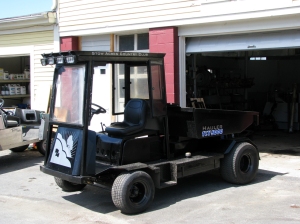
Last year we purchased a Toro 5400 fairway sprayer, considered by most to be the Cadillac of sprayers. This replaced our very outdated Smithco Spraystar 3000. The vehicle itself was in decent enough shape, with just over 1000 hours on it. The sprayer part of the machine was in dire shape, however. With bent booms, sporadic lift actuators, a temperamental foaming system, and outdated calibration technology, it was time to upgrade to a more efficient sprayer. The Spraystar 3000 sat unused last season.


We manage a large property here at Stow Acres. With such a historic country club, we spend a fair amount of time renovating and renewing features of the course to their intended beauty. Moving material across the course for this task has proven to be labor intensive and troublesome on the equipment. The 90+ years of golf played on some parts of this property has developed a character of undulating turf, which is sometimes tough on the lighter utility vehicles we have, which are constructed with aluminum frames and relatively small cargo beds. The need to move large amounts of dense material such as sand, soil, stone, and cart path material could be filled by the same machine that was built to carry 3000 lbs of water.

We began by stripping the Spraystar of it’s sprayer components. The booms, tank, pump, electronics, computer, foamer, and lines were all removed.


From there, we began to prep for paint. The acrylic windows were removed, all loose rust was sanded smooth, body filler was applied to any dented or mis-shapen area, and primer applied over those spots.


The vehicle was then painted GM Onyx Black with a one step urethane paint. The frame and gondola dump box arrived and were placed on the chassis.


The lift cylinder was installed and plumbed to the lift valve.


Lights were added to the roof, and a hitch constructed for trailering our Toro Procore 648 aerator.


With the lift cylinder in operation, we tested out a load of stone in the bed:


Custom decals finished off the project:


________________
Justin Parker
Equipment Manager
Stow Acres Country Club
http://golfcoursetech.wordpress.com/

Justin is a devoted Christian, husband, father to two daughters, golf course mechanic, entrepreneur and web enthusiast.  

Justin attended UMass Amherst, where he studied Mechanical Engineering, Computer Science, Mathematics, and 3D Modelling and Animation and has completed the Turfgrass Management Certificate Program at Ohio State University. Justin works at Stow Acres Country Club in Stow, Massachusetts. Stow Acres is a 36 hole, semi-private, family owned facility.
In addition to working at Stow Acres, Justin owns Synergy Offroad, a 4×4 enthusiest ecommerce site. 

Rainwater Harvesting - Roof, Parking lot, Filter, Storage, Irrigation

Here's a quick look at a rainwater harvesting project at Boerner Botanical Gardens near Milwaukee, Wisconsin. Ed Beaulieu of Aquascape, Inc walks us thru a rainwater harvesting system and a permeable paver patio which is designed to capture the rain water from the roof and the parking lot of the facility. Boerner Botanical Gardens can then utilize the rain water for irrigation on their property; as well as provide habitat for wildlife and protection of the downstream watershed by controlling erosion.