Several years ago when a flock of wild turkeys showed up at the golf course one morning we were all really excited. An occasional single turkey had been seen on the golf course in the past but never a flock this size.
In an effort to try to entice them to stay and take up residency on the golf course we looked at our habitat and resources for them to thrive. The habitat of the golf course is very adequate for their survival with several movement corridors, native grass corridors, and plenty of trees to roost in for the night. The part we were missing was a good food source so we created some supplemental turkey feeders to provide them with shelled and cracked corn until we could install some food plots for them.
Stakeholder Coalition Develops Best Practice for Water Management in Marrakech
Marrakech, the Moroccan Imperial city, is strategically located close to the Atlas mountains. In the early days, the city was the gateway to the Sahara desert and over the years, Marrakech developed into a unique touristic destination. An interesting destination also for golf tourism, showing the many golf courses around Marrakech. With 24.000ha, high summer temperatures, a total population of 950.000 people and nineteen courses, water is a valuable asset. To protect the city’s environment, a public-private collaboration was initiated to collect all the wastewater from the city, treat the water and reuse it for instance for irrigation of the Palm groves of Marrakech and golf courses.
Golf course superintendents have got to be some of the most knowledgeable, well-rounded individuals I know. When you think about all the subjects they’re expected to be proficient in, it’s really mind-blowing. I have a lot of respect for this profession. Not only do they need to know the ins and outs of the game, but they pretty much need to be landscape architects, mechanics, entomologists, gardeners, chemists, agronomists, botanists, soil scientists, arborists, wildlife managers, biologists, turfgrass specialists, plant pathologists, economists, weather forecasters, hydrologists, reclamationists, and even the occasional public relations professional. What’s more, they’re expected to be all of these things on top of keeping their players happy and coming back for more. If this list seems overwhelming, well, I’m sorry but I’m about to suggest one more. A wetland scientist. Golf course superintendents will need a good understanding of riparian sciences and knowledge of how to properly manage and maintain the health and quality of their ponds, streams, rivers and lakes if they are to succeed in the future of sustainable golf course management.
Weston GC, Toronto, Ontario - Project of Out on a Limb
One of the most important cultural practices here at Stow Acres Country Club is spraying our greens, tees and fairways. On average, we spray twice each week. We have two dedicated sprayers, one 175 gallon Spraytek DS175 for greens and tees, and a 300 gallon Toro Multipro 5700 for fairways. Given the volume of the tanks, and the precision with which the sprays are mixed, it can take upwards of an hour to fully load the sprayer. Each spray is typically 2-3 loads, which requires 2-3 hours or more of mixing and loading the spray. This season, we decided to change the process up a little.
The idea for the Purple Tee’s at Overlake Golf & Country Club came out of a committee meeting last year when one of our members who liked the idea of a shorter course came to the meeting prepared with some information about the Tee it Forward initiative and some of their recommended yardages for players of varying abilities. It was met with some skepticism and indifference, as many golfers don’t like to do anything that would give the perception of making the course easier, but we wanted to at least look into it as it was sincerely brought up to help both older members and younger members enjoy the game.
Shortly after I accepted the Assistant Golf Course Superintendent’s position at Overlake Golf & Country Club, it was a goal of mine to guide the club through the process of becoming a Certified Audubon Cooperative Sanctuary through Audubon International. I had been involved with the program at other clubs and knew what a great tool it could be to highlight environmental excellence at Overlake.
The first section of the certification process, Environmental Planning, was challenging for me as it involves a lot of information gathering. This section requires a description of all of your site information and development of a general plan on how you will institute all of your environmental programs. It also sets up your plan for the subsequent five sections, so I wanted to devote significant time to it.
I was tempted at first to take on everything myself, but soon found out that it was just too time-consuming to complete all of the paperwork, institute new environmental programs and manage the staff to ensure we were maintaining exceptional playing conditions on a daily basis. While course conditions continued to improve, and major projects were being implemented on the golf course, I was a bit frustrated with how slowly the Audubon program was progressing. I finally came to the conclusion that, in addition to my day-to-day responsibilities of managing the course, there just weren’t enough hours in the day to accomplish this undertaking on my own.
2nd Assistant Superintendent Marcus Harness and Horticulturist Lacey Leinbaugh explaining the difference between native and exotic plants to the students of St. Thomas School
Last year we purchased a Toro 5400 fairway sprayer, considered by most to be the Cadillac of sprayers. This replaced our very outdated Smithco Spraystar 3000. The vehicle itself was in decent enough shape, with just over 1000 hours on it. The sprayer part of the machine was in dire shape, however. With bent booms, sporadic lift actuators, a temperamental foaming system, and outdated calibration technology, it was time to upgrade to a more efficient sprayer. The Spraystar 3000 sat unused last season.
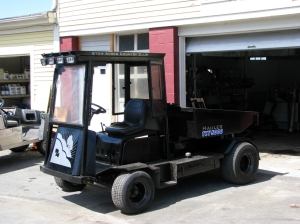
We manage a large property here at Stow Acres. With such a historic country club, we spend a fair amount of time renovating and renewing features of the course to their intended beauty. Moving material across the course for this task has proven to be labor intensive and troublesome on the equipment. The 90+ years of golf played on some parts of this property has developed a character of undulating turf, which is sometimes tough on the lighter utility vehicles we have, which are constructed with aluminum frames and relatively small cargo beds. The need to move large amounts of dense material such as sand, soil, stone, and cart path material could be filled by the same machine that was built to carry 3000 lbs of water.
We began by stripping the Spraystar of it’s sprayer components. The booms, tank, pump, electronics, computer, foamer, and lines were all removed.
From there, we began to prep for paint. The acrylic windows were removed, all loose rust was sanded smooth, body filler was applied to any dented or mis-shapen area, and primer applied over those spots.
The vehicle was then painted GM Onyx Black with a one step urethane paint. The frame and gondola dump box arrived and were placed on the chassis.
The lift cylinder was installed and plumbed to the lift valve.
Lights were added to the roof, and a hitch constructed for trailering our Toro Procore 648 aerator.
With the lift cylinder in operation, we tested out a load of stone in the bed:
Custom decals finished off the project:
________________ Justin Parker Equipment Manager Stow Acres Country Club http://golfcoursetech.wordpress.com/ Justin is a devoted Christian, husband, father to two daughters, golf course mechanic, entrepreneur and web enthusiast. Justin attended UMass Amherst, where he studied Mechanical Engineering, Computer Science, Mathematics, and 3D Modelling and Animation and has completed the Turfgrass Management Certificate Program at Ohio State University. Justin works at Stow Acres Country Club in Stow, Massachusetts. Stow Acres is a 36 hole, semi-private, family owned facility. In addition to working at Stow Acres, Justin owns Synergy Offroad, a 4×4 enthusiest ecommerce site.